
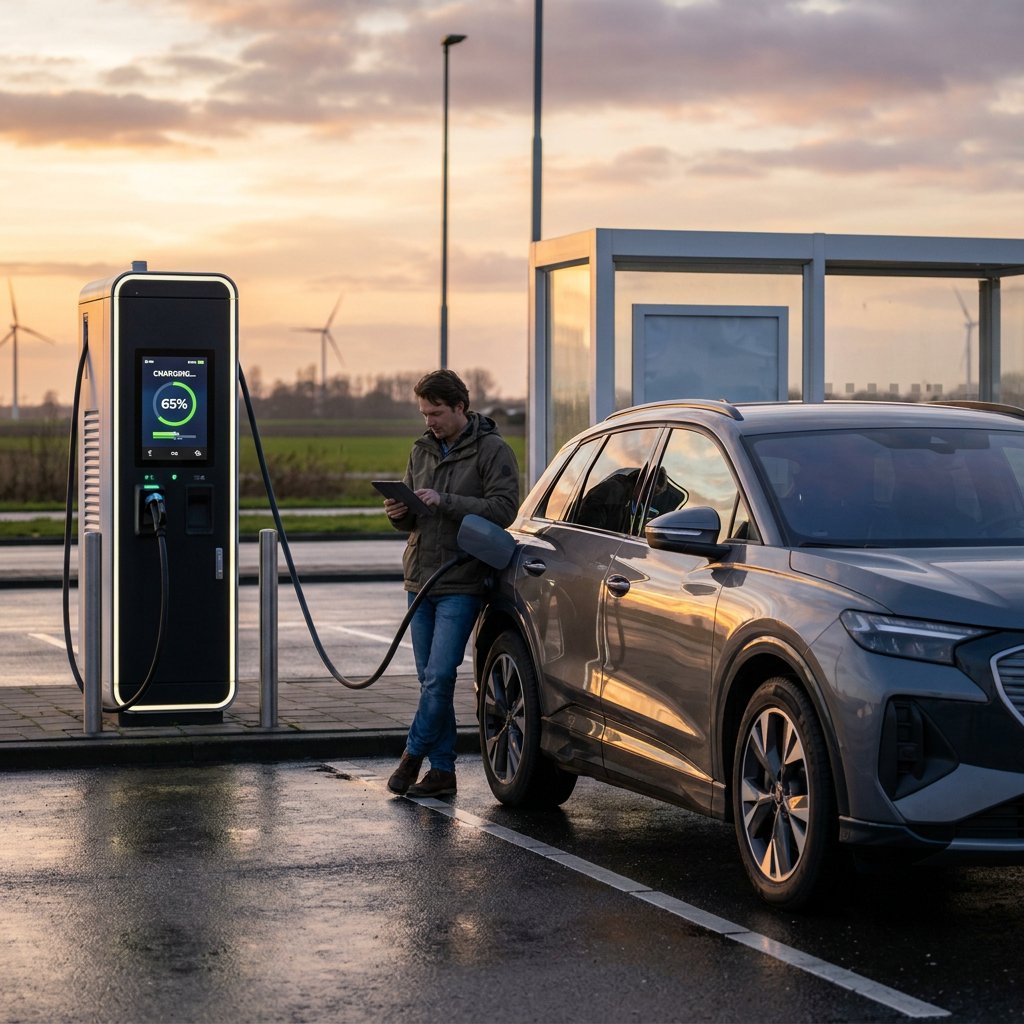
No, occasional rapid charging is usually not a problem for the battery in a modern electric car. The real issue is not sudden damage but accelerated ageing: if you charge very frequently at high DC power, especially in unfavourable temperatures or to high states of charge, you may lose capacity slightly faster over time.
That distinction matters. A battery does not usually fail outright after a single session at a rapid charger; it is usually a matter of gradual degradation over years. So pay particular attention to four factors: state of charge, battery temperature, charging frequency, and the difference between daily AC charging and DC rapid charging for journeys.
What happens in the battery during rapid charging
During rapid charging, the car is supplied with high-power direct current. Even so, the charge point does not independently determine how much energy the battery actually takes in. Via the battery management system, the car measures temperature, voltage and state of charge, among other things, and only allows what falls within safe limits. Curious how negotiated power delivery works in smaller devices? See USB‑C charging: the data explained.
That is why an EV usually charges fastest when the battery is neither nearly empty nor already very full. As the charge percentage rises, the charging speed naturally falls. That tapering of the charging curve is normal: it helps limit heat build-up and prevents unnecessary strain on the battery cells. So if you see on a rapid charger that a high peak speed is not maintained for long, you are in fact looking at built-in battery protection.
Temperature also plays a major role. A cold battery can charge less quickly, while a warm battery is monitored even more closely to prevent overheating. In both cases, the battery management system deliberately reduces the charging current. Precisely because of that, rapid charging in modern EVs is generally controlled, not unrestrained. For phones and laptops, choosing the right cable also helps keep heat in check; see Choosing the right USB‑C PD cable.
When rapid charging does cause extra battery degradation
So anyone who wants to know whether rapid charging is bad for the car battery will not get a black-and-white answer. Occasional rapid charging is part of normal EV use. Extra battery degradation mainly arises when DC rapid charging makes up a large share of all charging sessions and you often charge in demanding conditions.
| Situation | Effect on the battery |
|---|---|
| Occasional rapid charging on the road | Usually a limited effect. For modern EVs this is normal use, especially if you do not routinely charge all the way to 100%. |
| A small share of rapid-charging sessions in your total | Research broadly shows that annual degradation then often remains limited and does not differ greatly from predominantly AC charging. |
| Frequent high-power DC rapid charging | More heat and higher strain can make capacity decline faster, especially if this becomes your regular charging pattern. |
| Rapid charging with an already warm battery | Extra heat is unfavourable for battery cells. The system often slows down, but the wear load is still higher than in milder conditions. |
| Regularly charging above about 80% | The final part of the charge is slower and more demanding for the cell chemistry. It is precisely there that the charging speed deliberately tapers off. |
| Often charging all the way to 100% | Not directly harmful, but structurally less favourable than charging in the middle range of the battery. Fully charging is mainly useful if you need that extra range immediately. |
| Modern EV with buffers and protection | "Bad" usually means ageing faster, not the battery suddenly becoming defective. Buffer zones and protection limit direct damage. |
In short: rapid charging is not necessarily bad for the battery, but frequent and unnecessary rapid charging can make usable capacity fall faster.
How to keep rapid charging gentle on your battery
With a few practical choices, you can keep rapid charging efficient and relatively gentle on the battery:
- Use AC charging as the basis for your daily routine. Slower charging at home, at work or at a regular charge point is usually the gentlest option for the battery.
- Use rapid charging mainly when saving time on the road really matters. DC rapid charging is designed precisely for occasional long journeys.
- In many situations, it is better to charge between about 10 to 20% and 80% than to routinely run the battery right down or fill it completely. That charging window is often better for battery lifespan.
- Base it on battery percentage and the use case, not on a fixed number of kilometres. Waiting until you are almost at 0% is usually unnecessary; topping up before the battery becomes very low is often more practical.
- Only charge to 100% if you genuinely need the full range, preferably just before departure rather than long in advance.
- Take the weather into account. Extreme heat or cold adds extra strain, while pre-heating or battery preconditioning before rapid charging can help if your car supports that function. Wireless charging standards also differ in efficiency and heat; QI2 vs MagSafe explained.
What determines how fast your car can rapid charge and whether it can at all?
Whether you can rapid charge is not determined by the charge point alone, but by the combination of the car, the plug type and the maximum DC charging power. A powerful charger can only deliver what your car can actually accept. If you are at a 150 or 300 kW station but your EV supports a lower power level, the car will simply take in less.
That is also why a more powerful rapid charger does not force damage by itself. The car limits the power it takes in via the electronics and the battery management system. Similarly for phones, Charging your phone with a laptop charger — safe or not? explains why a higher‑wattage adapter won’t harm a device that requests less power. The actual charging speed may also be lower than you expect because of a cold battery, a warm battery, an already high state of charge or shared power at the location. It also regularly happens that drivers think they are rapid charging when they are actually using an AC connection instead of a DC charger.
If you want to know what applies to your model, check the manual or technical specifications for terms such as maximum DC charging power, supported plug standard and charging time from 10 to 80%. Many modern EVs, including versions of the Hyundai Kona EV, can rapid charge. Even so, model year, battery pack and trim level always remain decisive for what is possible in practice.
How long does an EV battery last under normal use?
Under normal use, an EV battery usually loses capacity gradually rather than suddenly failing. In a lot of real-world data, well over 80% of usable capacity often remains after several years, although this depends heavily on battery technology, temperature, driving profile and charging behaviour. Manufacturers also build in buffers, thermal management and protected charging windows to moderate wear. Because of that, occasional rapid charging is rarely the only decisive factor. More frequent charging to 100%, leaving the car standing with a full battery for long periods, lots of heat and sustained heavy DC use together are more likely to determine how quickly capacity declines. For tips to slow wear in everyday phones, see Phone battery draining fast?
Looking for certified accessories for your other devices? Shop chargers and cables.