
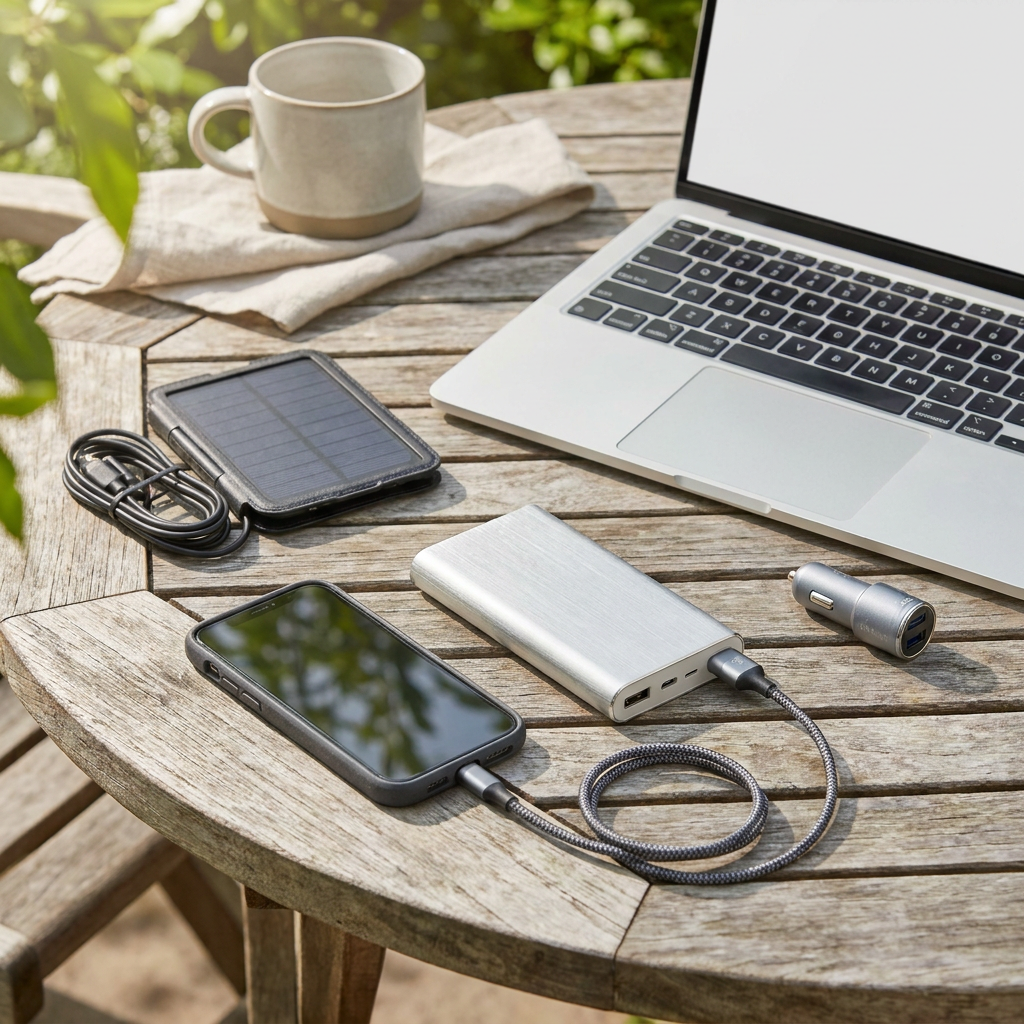
Yes, charging a phone without mains power is possible, as long as you have an alternative power source. The safest options are a power bank, a car, a laptop, a portable solar panel or reverse wireless charging. If you want to charge a mobile phone without power, charge a phone without a power outlet or even charge a mobile phone without a charger, capacity, compatibility and safety are what matter most.
A power bank remains the most reliable solution
For most situations, a power bank is by far the best choice. You charge it in advance and use the stored energy later wherever you want. That makes it the fastest way to charge a phone without a power outlet, for example when travelling, on holiday, at a festival or during a power cut at home.
How much capacity do you need?
A 10,000 mAh power bank is enough for around 1 to 2 charges for many users. If you use your smartphone heavily for navigation, video or as a hotspot, 20,000 mAh is often the smarter option. If you want to charge a phone battery without a charger, in practice you get the most convenience from a model with fast charging, so you quickly have enough battery again.
What should you look for in quality and compatibility?
Always check whether the outputs match your cable and device, such as USB-C or Lightning. If you have an iPhone with a Lightning port, an Apple MFi-certified cable is a safe choice. Also look for CE- and RoHS-compliant accessories and avoid unknown, poorly made chargers. It is better not to store a power bank for long periods in extreme heat or cold, because that shortens the battery's lifespan.
Charging via a car, laptop or another phone
In the car
If you do not have a power bank with you, the car is a practical backup. You can do this via a USB port in the car or via a 12V car charger. This works well for a quick top-up on the road. Just do not leave your phone charging for too long with the engine off, because then you draw power from the car battery.
Via a laptop or computer
A laptop with enough battery can also charge your smartphone temporarily. This is usually slower than through a power outlet, but it is a usable emergency solution. Preferably connect your device directly to the laptop and not through a USB hub, so the charging current stays more stable.
With reverse wireless charging
Some smartphones can charge another phone wirelessly. Manufacturers call this, for example, Wireless PowerShare, Battery Share or Reverse Wireless Charging. Place both devices against each other or in the correct position and activate the function in the settings. This only works if both devices are compatible, and it is mainly intended as a short emergency top-up.
Solar power and emergency solutions
Solar charger or solar power bank
For longer periods without mains power, solar power is worth considering. A foldable solar panel usually delivers more than a small solar power bank, especially in good sunlight. In practice, it often works best to charge a power bank first and only then your phone. In cloudy weather, shade and short winter days, expect much lower output.
Hand-crank radio for emergencies
A hand-crank radio with a USB output is not a comfortable everyday solution, but it is valuable in real emergencies. By turning the crank, you generate power yourself. It often also includes a flashlight and emergency radio function. Do not expect a full charge, but enough power to stay in touch.
The right cables, safe choices and how to save battery
Without a good cable, any charging source is of little use. People searching for charging a phone without a charger usually mean without a power outlet. In that case, a cable or wireless charging option is still usually needed. That is why you should carry at least a suitable USB-C or Lightning cable. If you use multiple devices, a compact emergency cable set is especially handy.
Avoid damaged cables, unreliable adapters and public USB ports when you do not know where they come from. They can be slow, unsafe or even risky for your data. If you still cannot charge yet, stretch your battery with a few quick steps:
- turn on battery saver mode
- lower the screen brightness
- turn off Bluetooth, GPS and 5G if you do not need them
- use airplane mode if you only need to be reachable for emergencies
Frequently asked questions
How can I charge my phone without a cable?
Only wirelessly, for example with a Qi charger or with reverse wireless charging from another smartphone. So charging a mobile phone without a charger and without a cable is only possible if your device supports wireless charging.
How do I know whether my phone can charge wirelessly?
Check your device specifications or look in the settings for Qi, wireless charging or battery sharing. More and more mid-range and high-end smartphones support this, but it is certainly not standard on every model.
How can I charge my phone wirelessly?
Place your smartphone centrally on a compatible wireless charger and check whether the charging icon appears. With reverse charging, first activate the function on the phone that is sharing power and then place the other device in the right spot.
Which phone can be charged wirelessly?
Many recent iPhones, various Samsung Galaxy models, Google Pixel devices and other modern smartphones support wireless charging. Always check the product specifications, because this can vary by series and year of release.
Does a charger use power without a phone?
Yes, a charger does use power without a phone, although with modern chargers this is usually limited. If you leave many adapters permanently plugged into the power outlet, that small amount of power use still adds up. You save energy by unplugging them when you are not using them.
If you head out prepared with a good power bank, a suitable cable and certified charging accessories, you can keep using your smartphone reliably even without mains power.