
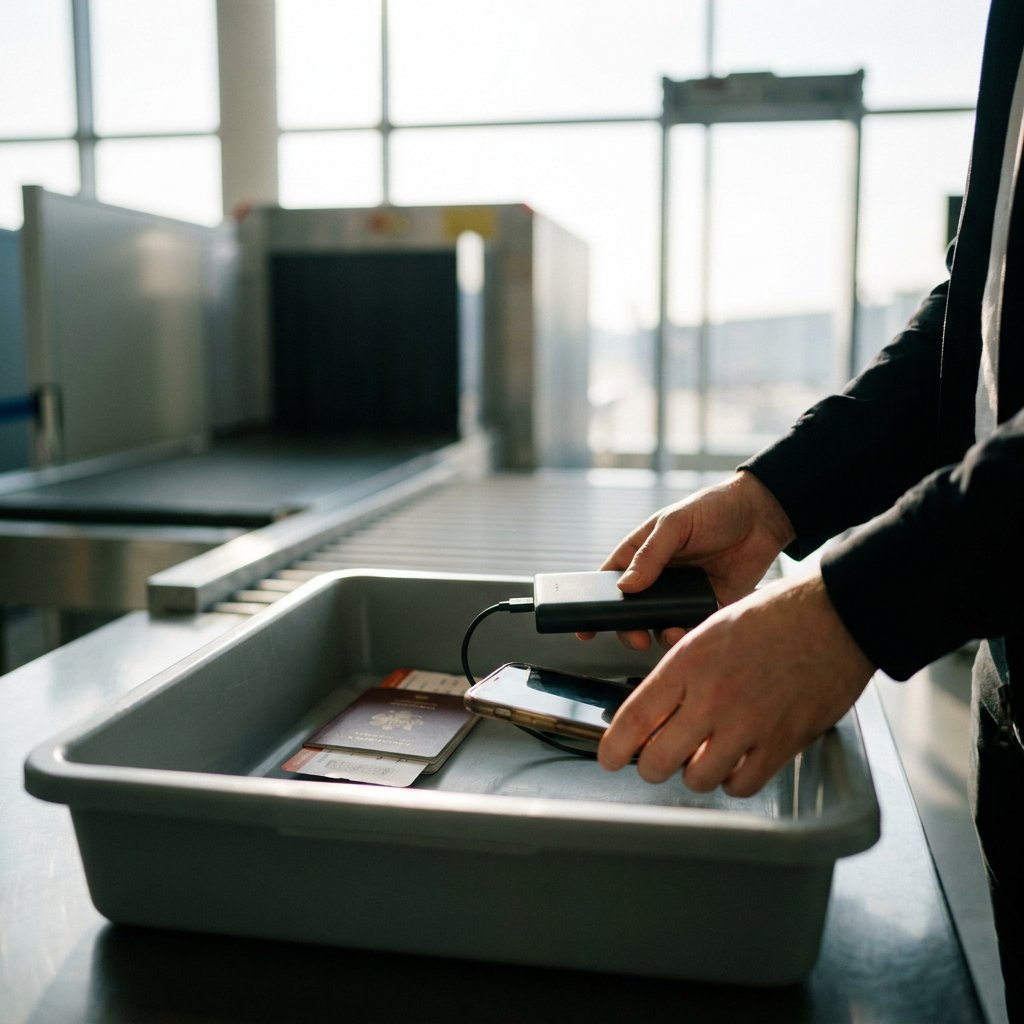
A power bank is useful when travelling, but clear rules apply on planes. In practice, it mainly comes down to three points: a power bank normally belongs in hand luggage, not in checked baggage, and its capacity must stay within the permitted limit. On this page, you can read what to look out for so you can make the right choice for your flight more quickly.
If you are looking for a power bank for travel, it is smart to look not only at mAh, but also at the stated Wh value, the size and the visible product marking. For most travellers, a compact or medium-sized power bank is the safest and most practical choice within the range of power banks and chargers.
Can you take a power bank on a plane?
Yes, you can usually take a power bank on a plane, but almost always only in your hand luggage. The reason is that power banks contain lithium-ion batteries. Airlines and safety authorities therefore restrict how these batteries may be transported.
The main rule of thumb is simple: take your power bank in your cabin baggage and always check your airline’s current rules before departure. Airlines often follow the same basic guidelines, but details may differ.
Hand luggage or checked baggage?
A power bank normally belongs in hand luggage and not in a checked suitcase. That is the safest choice and also the rule travellers are checked on most often.
- Hand luggage: usually allowed within the applicable capacity limits
- Checked baggage: usually not allowed
- At gate check: a power bank often has to be removed from the bag or suitcase before it is placed in the hold
Also make sure the ports are protected and that the power bank is not damaged. Good travel accessories for on the go can help you carry your tech safely, while a visible capacity label can be useful during checks.
How large can a power bank be on a plane?
For air travel, the focus is usually on watt-hours, abbreviated as Wh. That is more important than just the number of mAh.
- Up to 100 Wh: usually allowed in hand luggage
- 100 to 160 Wh: sometimes only with prior approval from the airline
- Above 160 Wh: generally not allowed for passengers
In practice, a 20,000 mAh power bank usually falls well within the 100 Wh limit and is therefore a logical choice for many travellers. Many 10,000 mAh models also stay safely below this limit. With larger models, it is wise to check the product specifications before you leave.
mAh and Wh: what should you watch for?
Many consumers mainly see mAh on the packaging, while airline rules are usually expressed in Wh. That is why it is sensible to always check both values if they are listed.
If only mAh is stated, you cannot automatically assume that a power bank is allowed without question. Voltage also plays a role in the calculation. In practice, the familiar 100 Wh limit often comes down to about 27,000 mAh at standard cell voltage. As a result, a 20,000 mAh power bank usually still falls within the common limit, while larger models require extra checking.
Which power bank is most practical for travel?
For air travel, not only the permitted capacity matters, but also ease of use while on the go. Preferably choose a model that suits your devices and travel duration.
- For short trips: a compact model is often sufficient for charging your smartphone while travelling
- For longer travel days: a larger power bank can be more convenient if you want to charge multiple times
- For multiple devices: check the number of ports and whether USB-C is needed for your device
- For inspections: preferably choose a power bank with a clear capacity indication on the product
AZCOM sells power banks from brands including Celly, Samsung and Apple. Within that range, 20,000 mAh models are interesting for travellers who want extra capacity without immediately moving towards the highest permitted limit. Also do not forget to bring suitable USB-C and Lightning cables.
Travel safely with a power bank
A suitable power bank for air travel is not only compact and powerful, but also clearly marked and in good condition. Do not use a swollen, damaged or poorly functioning power bank. Store the device during your trip so it cannot be crushed or short-circuited by loose metal objects.
If you want to avoid problems at security or the gate, check these points before departure:
- Take the power bank in your hand luggage
- Check the Wh or capacity marking
- Choose a model with clear product marking
- If in doubt, review your airline’s rules
- Do not use a damaged power bank
FAQ
Can I take a 20,000 mAh power bank on a plane?
In many cases, yes. A 20,000 mAh power bank generally falls under the common 100 Wh limit and can usually be taken in hand luggage. To be safe, always check the product specifications and your airline’s rules.
Why is a power bank usually not allowed in checked baggage?
Because power banks contain lithium-ion batteries. In the event of an incident, rapid detection and intervention in the cabin are more important than in the hold. That is why they generally have to be carried in hand luggage.
Can you use a power bank on a plane?
That depends on the airline and sometimes also on the moment during the flight. Some airlines allow use, others impose restrictions. Therefore, always check the onboard instructions and the current airline rules. If you are also looking for compatible travel solutions, take a look at our MagSafe accessories.
Which power bank can you take on a plane with Transavia?
The exact conditions may change, but in principle the same rule applies there too: power banks normally belong in hand luggage and must stay within the permitted capacity limits. Always check the latest Transavia conditions before departure or read more travel tips and product advice.