
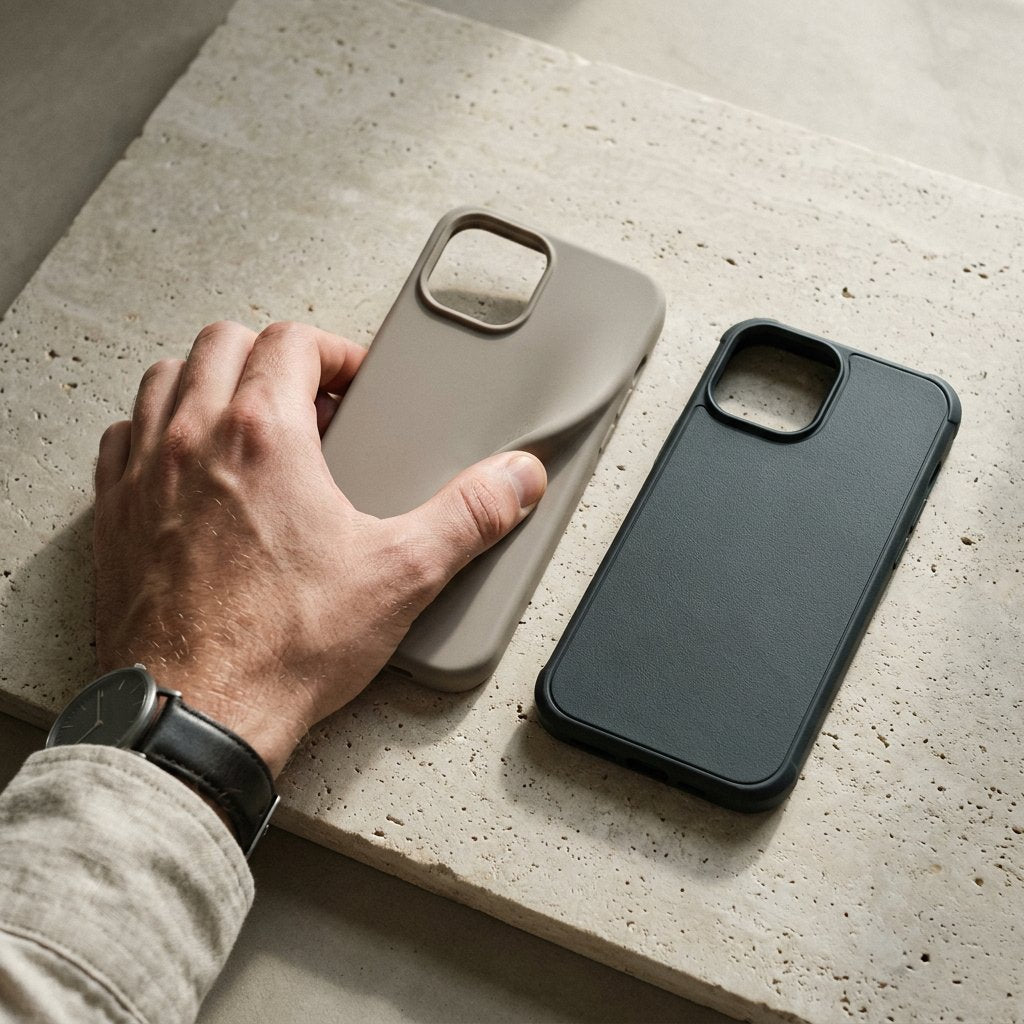
The core difference is simple: TPU is a flexible plastic that is firmer, holds its shape better and is more hard-wearing, whereas silicone feels softer and has more of a rubber-like character. You notice that straight away with phone cases. TPU often scores more strongly for structural protection and usually keeps a snug fit around the phone for longer. Silicone stands out more for grip, comfort and a pleasantly soft feel in the hand.
Which choice is best therefore depends not only on the material itself, but above all on how you use your phone. Are you often on the move, do you sometimes drop your device, or do you want a slim case that keeps looking neat? Then TPU often comes out ahead. Are you mainly looking for extra grip, softness and a comfortable feel? Then silicone is an attractive option. The type of case also plays a role, such as a protection case, a book case or a MagSafe case, where the overall construction is at least as important as the outer material.
The properties you notice immediately in a case
With a phone case, you feel the material not only in your hand, but also in day-to-day use, in your pocket and during an unexpected drop. These are the differences that really matter.
| Property | TPU | Silicone | What this means in practice |
|---|---|---|---|
| Grip | Good grip, especially with a matte or lightly textured finish. | Very grippy and often immediately less slippery in the hand. | Silicone is usually less likely to slip; TPU feels slightly more neutral and may come out of a trouser pocket more easily. |
| Softness | Flexible, but clearly firmer and less yielding. | Softer, more supple and more rubber-like. | Silicone feels more comfortable; TPU gives a sturdier, more technical impression. |
| Drop cushioning | Generally absorbs shocks well and helps distribute impact across edges and corners. | Pleasantly cushions minor knocks, but is not automatically stronger in heavier impacts. | For everyday protection, TPU often has the edge, especially in a well-designed protection case. |
| Scratch and wear resistance | Usually better able to withstand scuffing, scratches and intensive use. | May show signs of wear more quickly because it is softer. | TPU often stays looking neat for longer if the case frequently goes in and out of a bag or pocket. |
| Shape retention | Usually keeps a snug fit for longer. | Can stretch more easily over time. | If you remove the case often, TPU generally shows deformation less quickly. |
| Slim profile | Can remain relatively thin without immediately becoming too flimsy. | Often feels slightly fuller or softer around the phone. | For a slim, sturdy case, TPU is often more practical. |
| Ageing | Usually ages more evenly and keeps a snug fit for longer. | Over the longer term, is more likely to stretch, tear or discolour. | With intensive daily use, TPU often keeps its original shape for longer. |
| Price level | Widely available across different segments. | Varies considerably by finish and design. | The final price depends not only on the material, but also on construction, finish and brand. |
What TPU material actually is
TPU stands for thermoplastic polyurethane. It is a material that combines the flexibility of a soft case with more toughness and structure than many other flexible options. That is exactly why TPU is widely used for phone cases that aim to combine protection with a slim profile.
In practice, TPU helps absorb and spread shocks, especially along edges and corners. In addition, a good TPU case often keeps a snug fit around the phone for longer. TPU also generally performs strongly in terms of wear resistance, scratch resistance, tear resistance and day-to-day contact with, for example, skin oils or friction. However, quality still depends on the overall construction: thickness, finish, fit, edge height and corner protection are at least as important as the material itself.
Where silicone excels and where the limits lie
Silicone excels above all in feel and grip. The material feels soft, grippy and comfortable, which can make a phone nicer to hold and less likely to slip from your fingers. Many users especially appreciate that pronounced rubber-like character, particularly if comfort and hold matter more than a sleek, sturdy look.
Silicone also feels forgiving with minor knocks. At the same time, that is also where its limits lie. Because silicone is softer, it is often less hard-wearing and less shape-retentive than TPU. With intensive use, a silicone case is generally more likely to stretch, tear or discolour. That is why silicone is a strong choice if you are mainly looking for grip and softness, but not automatically the best option if maximum long-term durability is the priority. Whichever you choose, learn how to clean a phone case safely to keep TPU or silicone looking good.
Which case best suits your use
You do not choose the best case by material name alone, but by the combination of material, design and your day-to-day use.
- Do you use your phone intensively, are you often on the move, or is the risk of drops greater? Then a well-designed TPU case or hybrid protection case is usually the better choice. It often offers the best balance between shock absorption, sturdiness and shape retention.
- Are you mainly looking for softness and extra grip in the hand? Then a silicone case is often a better fit. It feels comfortable and is less likely to slip, although you usually give up a little in long-term durability.
- Want to know which type of case protects best? Explore protective phone cases with TPU or a hybrid construction, ideally with reinforced corners and raised edges around the screen and camera.
- Do you want extra screen coverage? Then a book case may be worth considering, because it also shields the front when the case is closed.
- Is the emphasis on looks and material feel? Then design plays a bigger role with leather phone cases, but even there the inner case remains decisive for real drop protection.
- Do you use magnetic accessories? With a MagSafe case, do not look only at the outer material, but above all at the sturdiness of the overall construction and the fit.
- In product specifications, always check the fit, edge height, corner protection, button coverage and any material combinations. That is often where you see the difference between basic protection and genuinely thoughtful design.
Frequently asked questions about choosing a case material
These are the short, practical answers to the questions that most often follow after comparing TPU, silicone, hard cases and soft cases.
Is TPU good?
Yes, TPU is a very strong all-round choice for many users. The material combines flexibility with sturdiness, so it generally absorbs shocks better than a rigid hard case while also maintaining its shape better than very soft materials. That is why TPU is popular for everyday use, especially when protection, grip and a slim profile all matter. However, not every TPU case is automatically very protective. The real performance still depends on how the case is built: the thickness, the reinforcement of the corners, the height of the edges and the quality of the fit make the final difference.
Does TPU last longer than silicone?
In many cases, yes. TPU generally keeps its shape for longer and often wears more slowly than soft silicone, especially if the case is used intensively. Over time, silicone more often shows typical ageing such as stretching, tearing or discolouration. That does not mean every silicone case wears out quickly, but if long-term durability matters, TPU usually has the edge. The actual lifespan still depends on the finish, the thickness of the material, the quality of the construction and how often the case is removed or put under heavy strain in a pocket, bag or on the move.
Which is better, a hard case or a soft case?
That depends on what matters to you. A hard case is more rigid and often looks slim and sleek, but when dropped, such a case can transfer more impact to the phone or crack itself. A soft case has more give. As a result, it usually absorbs shocks better and often offers more grip in the hand. A soft case made of TPU in particular is therefore more practical for many people in day-to-day use than a fully hard case.
Still unsure between the two? Then a hybrid case is often the smartest middle ground. For example, it combines a hard back with shock-absorbing edges, so you get both firmness and cushioning. For the best choice, do not look only at hard or soft, but at the overall construction, the corner protection, the raised edges and how well the case really fits around your phone.