
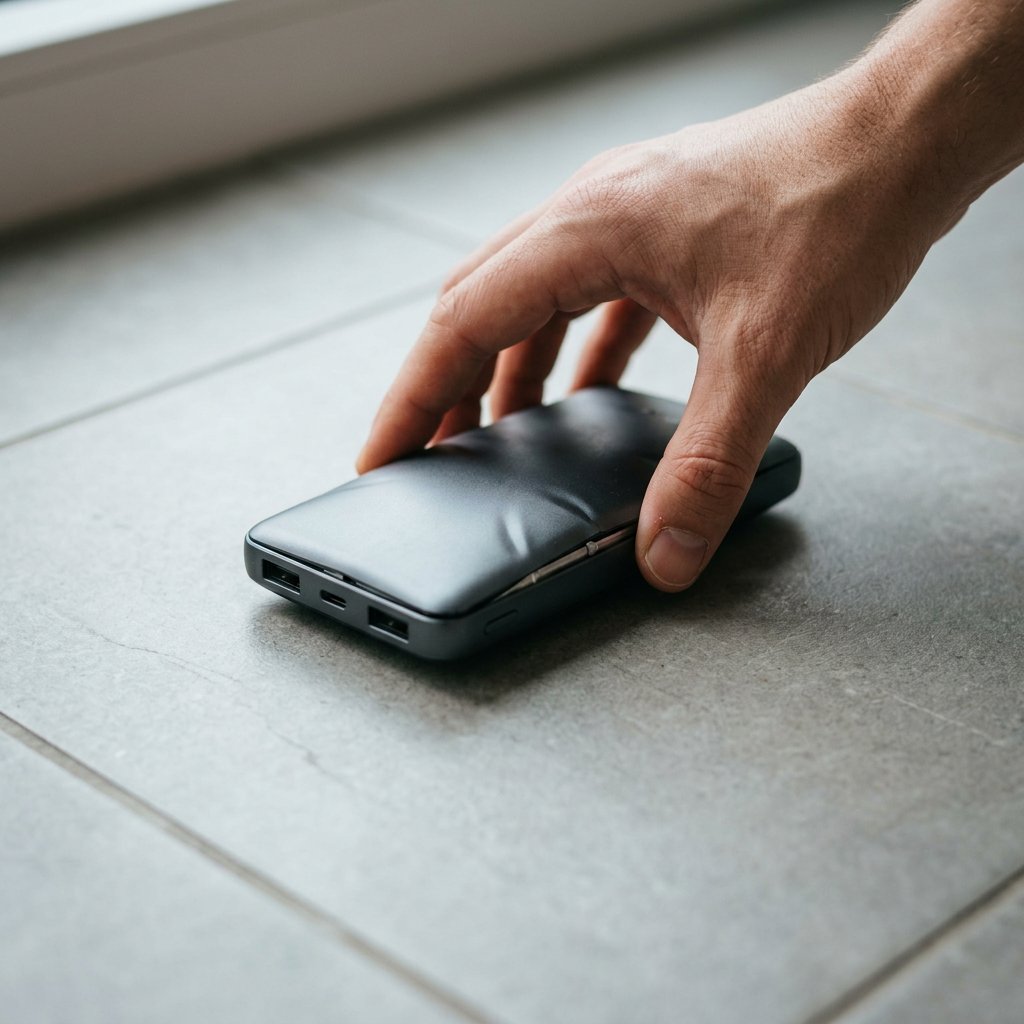
You must no longer use or charge a swollen power bank. Swelling indicates battery damage and increases the risk of short circuit, fire and leakage. Therefore, disconnect all cables immediately, place the power bank in a cool, dry, non-flammable place and never press in or open the casing. Below, you can read why this is dangerous, how to recognise it, what the causes are, how to hand in the power bank safely and when the warranty and returns process is relevant.
Why swelling is an immediate safety risk
A power bank contains lithium-ion cells that can swell due to gas build-up after heat, charging stress or internal damage. This can lead to short circuit, fire, leakage and, in severe cases, even explosion. The risk begins as soon as the casing bulges or the power bank becomes unusually warm, even if it still seems to work. Prolonged high temperatures, roughly above 45°C, greatly increase the likelihood of swelling.
Act immediately: how to make the situation safe
- Stop using and charging it immediately, disconnect all cables and switch the power bank off if that is possible.
- Place it on a cool, dry, non-flammable surface, away from sunlight, textiles, paper and other electronics.
- Do not press, bend or open the casing, do not puncture it, do not place it in water and do not attempt any repair.
- If it hisses, smokes, you notice a burnt smell or it becomes extremely hot, keep your distance and seek professional help if there is immediate danger.
How to recognise that your power bank is no longer safe
| Sign | Meaning |
|---|---|
| Bulging or warped casing, seams coming open, protrusion around USB ports, no longer lying flat | Clear indication of internal gas build-up; stop using it immediately. |
| Unusual heat | Slight charging warmth can be normal, but heat that rises quickly or coincides with deformation is suspicious. |
| Chemical or burnt smell, small cracks | May indicate damage to or leakage from the battery cell. |
| Jumping charge level, LEDs reacting strangely, unstable charging | Symptoms during use that may indicate battery damage, even if the power bank still partly functions. |
These are the most common causes of swelling
Swelling is usually caused by heat build-up, wear or internal defects, physical damage or incorrect charging. Think of a power bank in a hot car, on a windowsill behind glass, in direct sunlight or while charging next to a heat source. Charging a power bank for a long time in a poorly ventilated place is also risky; see how to charge a power bank safely and quickly. It is not only the outside temperature that matters: localised heat in the power bank or charger can be even more harmful. Incorrect, damaged or inferior chargers and cables increase that risk even further.
Smart charging and storage prevent many problems
- Always charge on a hard, cool surface and stop immediately if the power bank becomes noticeably warm.
- Do not leave it on the charger longer than necessary. Protection helps, but continuous charging remains unfavourable for older or already damaged batteries.
- A full power bank is often shown by steady LEDs or 100% on the display, but the exact indication varies by model; therefore always check the manual.
- Use suitable, undamaged charging accessories. If a power bank needs to be replaced, first determine how many mAh a power bank needs. If a cable or charger needs to be replaced, see the USB‑C PD cable wattage and compatibility guide to choose the right combination and avoid overheating; where relevant, look for CE/RoHS and Apple MFi.
- If you need to power a laptop, read choosing and using a laptop power bank to select the right capacity and outputs.
Hand in a damaged power bank safely
A swollen power bank does not belong in general waste. Hand it in at a shop with battery collection or at an official collection point such as Wecycle. Before transport, first allow the power bank to cool down and then keep it dry, separate from metal and other batteries, preferably in non-conductive packaging such as cardboard. Professional processing is the safest route and makes it possible to recover valuable materials from the battery. If a recall or warranty claim applies, stop using it immediately and follow the brand's or seller's return or replacement instructions. If you plan to travel, first check the rules on taking a power bank on a plane, especially if a battery is damaged or swollen.