
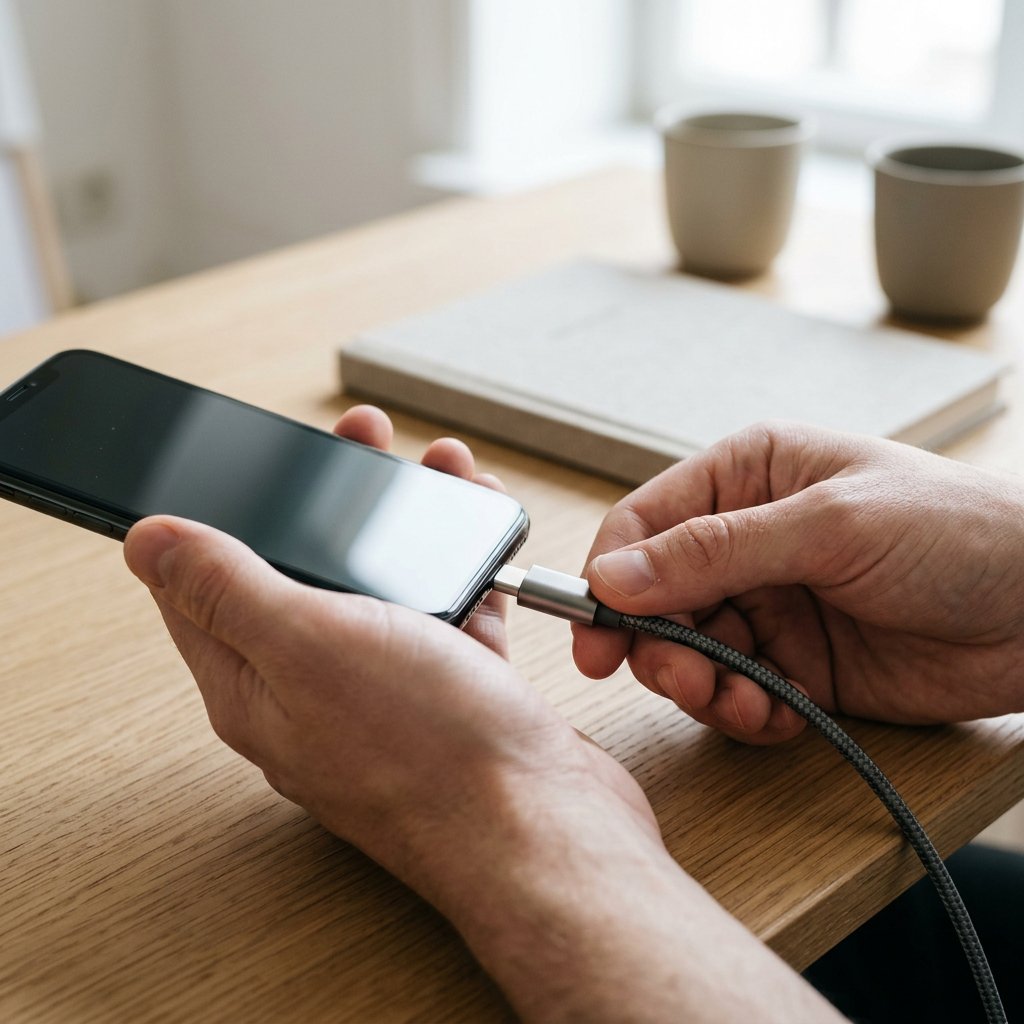
MFi is Apple’s licensing and certification programme for accessories that use certain Apple technologies. It supports compatibility by setting requirements for design and operation. Not every iPhone cable needs MFi certification: its relevance depends on the connector and technology used. At AZcom BV, you will find accessories for both wired and magnetic wireless charging for your mobile devices.
How does Apple’s MFi programme work?
MFi stands for ‘Made for iPhone/iPad/iPod’. The programme began in 2005 as ‘Made for iPod’. Participating manufacturers gain access to specific Apple technologies and develop accessories in accordance with the associated terms. MFi is therefore not a universally required certification mark for all accessories that work with Apple products.
What requirements does Apple set for an accessory?
Apple sets requirements for design, specified components, materials and manufacturing for each accessory category. These requirements determine how the relevant Apple technology is incorporated into the accessory. Applicable certification tests form part of the process: the product must meet the specifications for its category.
Reliable compatibility with your Apple device
In Lightning accessories, specified authentication components support recognition and communication with the connected Apple device. Compliance with Apple’s specifications therefore helps ensure compatibility. The device model, the USB‑C or Lightning connector and the supported functions also determine whether the accessory is suitable in practice. Certification does not guarantee continued operation with every future version of iOS.
For wireless charging, see the difference between MagSafe and Qi2 charging.
Safety, lifespan and performance: what can you expect?
- Safety: product requirements support stable charging and reduce risks such as overheating, but do not prevent every fault or instance of misuse.
- Lifespan: build quality, cable construction, wear and use determine reliability. MFi does not automatically mean a longer lifespan.
- Performance: USB‑C charging power and data transfer speed depend on the cable specifications, adapter and device.
- Price: assess any price premium on the basis of demonstrable quality and suitable specifications, rather than promises of automatic cost savings.
What can go wrong with a non-certified Lightning cable?
- Possible signs include an unsupported accessory message, interrupted charging or an unreliable data connection.
- A lack of certification does not prove that a cable is unsafe or unusable. Damage, dirt and a faulty connector can also cause problems.
- Start by inspecting the cable and connectors. Then check the adapter and test with a demonstrably suitable, undamaged cable. Stop using damaged components.
Does your iPhone have Lightning or USB-C?
| iPhone models | Connector | Cable required | Relevance of MFi |
|---|---|---|---|
| iPhone 5 through to the iPhone 14 series; first- through to third-generation iPhone SE | Lightning | USB-A-to-Lightning or USB-C-to-Lightning, depending on the adapter | Relevant to the Lightning end, even when the adapter end has a USB-C plug. |
| iPhone 15 and newer models | USB-C | USB‑C‑to‑USB‑C cable for a USB-C adapter | Standard USB-C-to-USB-C charging cables do not need MFi certification. The product specifications determine the supported charging power and data functions. |
Prefer magnetic wireless charging? Explore our certified MagSafe chargers.
How to identify an MFi-certified accessory
- The applicable ‘Made for’ badge on the packaging and the product’s certification information provide an initial indication.
- Apple’s official MFi accessory search tool allows you to compare the manufacturer and exact model for products included in its listings.
- A displayed logo is not conclusive proof on its own. Certification applies to the specific product, not automatically to the entire brand or range.
What does MFi certification mean for your statutory warranty rights?
For consumers in the Netherlands, statutory warranty rights are based on what they can reasonably expect from a product. There is no general fixed two-year period for these rights. Your rights against the seller are separate from Apple’s additional manufacturer’s warranty and MFi certification. Using a non-MFi accessory does not automatically invalidate all warranty rights. Damage demonstrably caused by an unsuitable accessory must be assessed separately.