
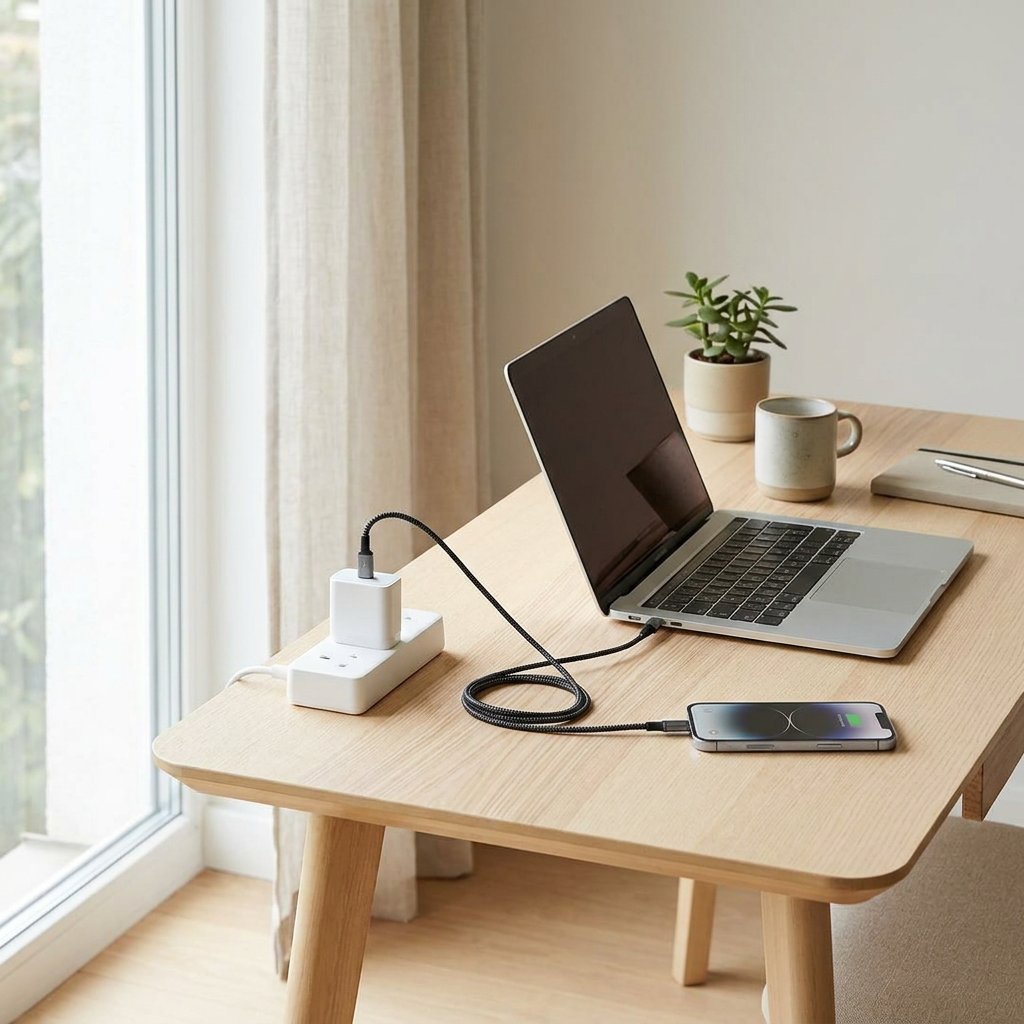
Yes, in most cases you can safely charge your phone with a laptop charger. Modern USB-C chargers in particular are suitable for this. The key conditions are a good cable, a reliable charger and as little heat as possible during charging.
When is a laptop charger safe for your phone?
A smartphone decides for itself how much power it accepts. If you have a 65W laptop charger but your phone supports a maximum of 20W or 25W, the phone will only draw that lower amount of power. So the charger does not automatically deliver too much power to your device.
With modern charging technology, the charger and phone communicate with each other first. That makes charging usually safe, even with a more powerful charger. As it gets closer to 80 to 100 percent, a phone also often deliberately reduces the charging speed to protect the battery.
What does 65W or 100W mean on a laptop charger?
The wattage on the charger indicates the maximum power it can deliver. It is not a fixed amount that continuously goes to your phone. So a higher number mainly means the charger has more capacity, not that your phone will actually use that capacity.
That is why high wattage by itself is rarely the problem. Poor electronics, unclear specifications or an unsuitable cable are a greater risk in practice. For background on USB‑C PD, wattage and compatibility, see Laptop opladen met een powerbank: zo werkt het.
USB-C and Power Delivery make the difference
USB-C is the connector, but USB Power Delivery, or USB-PD, is the standard that manages safe charging. If a laptop charger supports USB-PD, it can coordinate with your phone to determine which voltage and current are suitable. Specifications such as 5V, 9V, 12V, 15V and 20V are often a sign that PD is present. Not sure which connector your phone uses? USB‑C of Lightning: welke aansluiting heeft jouw telefoon?
Not every phone will then automatically reach the maximum fast-charging speed. Some brands use their own protocol. Your device will still charge, but sometimes more slowly than with the original charger. For an iPhone 11, it is best to use a good USB-C-to-Lightning cable with MFi certification.
When should you be careful?
Most problems are caused by poor-quality accessories or excessive heat. So pay attention to these points:
- Choose a charger with clear specifications and reliable build quality — see Opladers en laadaccessoires.
- Use a cable that is suitable for charging and not just for data — USB‑C en Lightning kabels.
- Avoid charging in direct sunlight, under fabric or while gaming heavily.
- Stop if the cable, plug or phone becomes unusually hot.
Heat is the biggest practical enemy of battery health. If your device gets warm, it often automatically reduces the charging speed. That is normal, but persistent heat is a sign to check the charger and cable.
Using a laptop charger or charging your phone via a laptop?
That is not the same thing. Charging with a laptop charger from a wall socket is usually faster than charging your phone via a USB port on the laptop. Through the laptop, you often get less power and charging can be slower or less stable.
If you want to charge your phone via a laptop, use a suitable cable and check whether the USB port actually supplies power, even when the laptop goes to sleep.
Quick check for safe charging
- The charger supports USB-C and preferably USB-PD.
- The cable matches your device and charging power.
- Charging remains stable without interruptions.
- The temperature stays normal during charging.
Frequently asked questions
Can I charge my iPhone with a laptop charger?
Yes, usually. For an iPhone 11, a USB-C-to-Lightning cable works, preferably with MFi certification. Newer iPhones with USB-C usually use USB-C-to-USB-C.
Why does charging via USB-C sometimes not work?
Not every USB-C port or cable supports charging in the same way. Dust in the port, wear or a faulty cable can also disrupt charging. For a deeper explanation of cable capabilities, see USB‑C‑kabels: laden en data — dit moet je weten.
Can I use a phone charger for my laptop?
Sometimes, but only if the laptop supports USB-C charging and the charger delivers enough power. In many cases, a regular phone charger is too weak for that.