
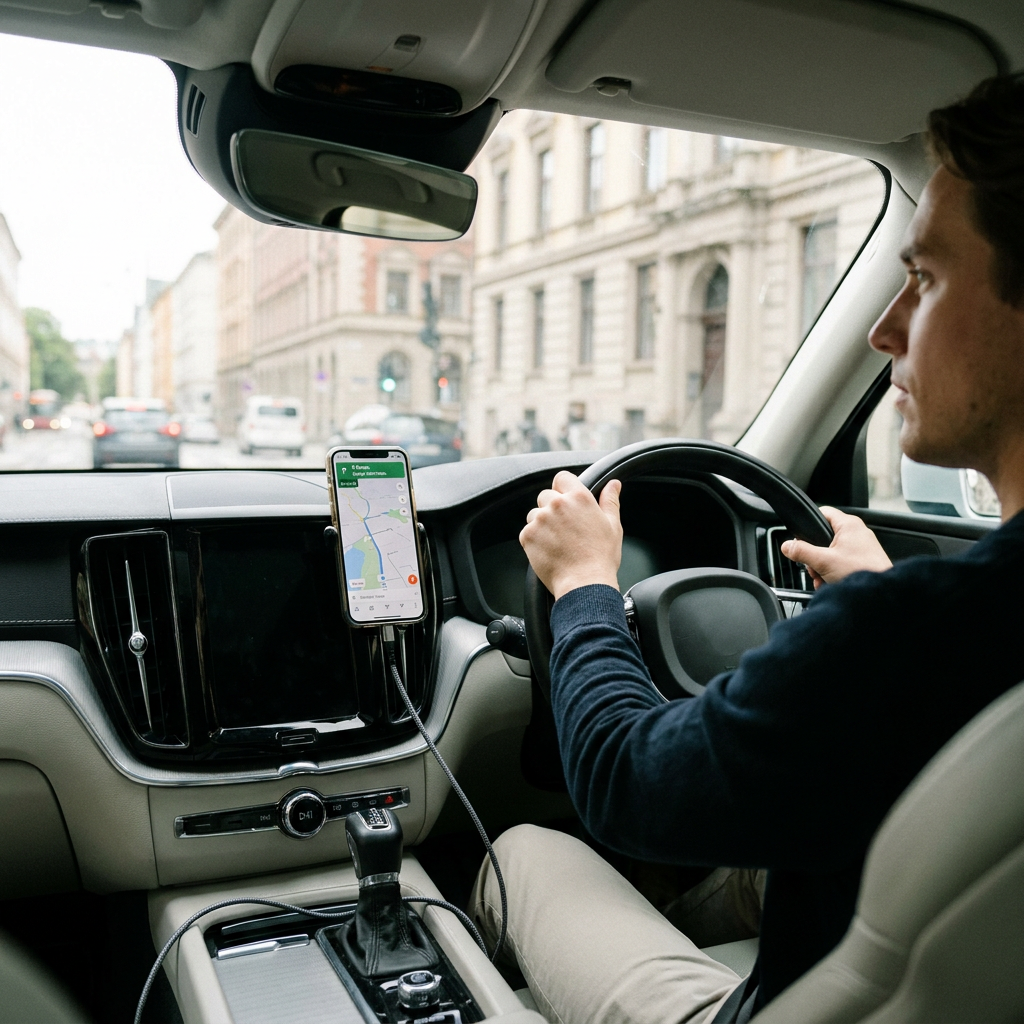
Charging your phone in the car can be done in four practical ways: via a 12V car charger, the built-in USB port, a wireless car charger or a power bank. The best choice depends on your device's charging capacity, the type of cable you use (see USB‑C or Lightning: which cable do you need?), and whether you also use navigation, Apple CarPlay or Android Auto while on the road.
For most drivers, a car charger in the cigarette lighter or 12V socket is still the fastest and most stable solution. If convenience and a tidy dashboard matter most, a phone holder for dashboard or air vent with charger is often the smartest upgrade.
Which charging solution suits your trip and device?
Charging via the 12V socket or cigarette lighter
A 12-volt car charger plugs into the cigarette lighter or 12V port in the car. The adapter converts the car's power into a safe USB output for your smartphone. That is exactly why this is still the most popular way to charge quickly and reliably.
Pay close attention to the output power. A simple car charger or fast car charger is fine for steady top-up charging, but while navigating, calling and streaming music, you need more power. Ideally, choose a model with USB-C Power Delivery or Quick Charge if your device supports it. The same applies to iPhone, Samsung and OnePlus: the charger may be powerful, but the device ultimately determines how many watts are actually used.
If you use multiple devices in the car, a dual-port charger is useful. This lets you charge two devices at the same time without constantly swapping cables.
Charging via the built-in USB port in the car
Many cars have a USB port in the dashboard, centre console or by the car stereo. This is convenient, but not always fast. In many models, this port is mainly intended for data, software connections or basic charging. As a result, the power output is often lower than with a separate charger for the 12V socket.
If you notice that the battery level barely rises while using GPS, the built-in USB port is usually too weak for your usage. It often works fine for short trips, but for longer journeys a separate fast charger is usually more effective.
Wireless car charger or phone holder with charger
A car phone holder with charger combines convenience with a fixed place for your device. You place the phone in the holder and charging starts automatically, without loose cables on the dashboard. This is especially practical when using navigation, because your screen remains visible and your cockpit stays tidy.
The downside is that wireless charging is usually less efficient than charging by cable. If the phone is not perfectly aligned with the coil, if the case is too thick or if the device is in direct sunlight, charging speed can drop. A wireless car charger is therefore ideal for convenient top-up charging, but less suitable if you want to get the most out of fast charging.
Qi and MagSafe in the car
If your device supports Qi, you can use a car Qi charger. For recent iPhones, a car MagSafe charger can be extra stable because the magnetic alignment improves the charging position. Do check whether your MagSafe case is compatible and whether the holder delivers enough power. Curious how MagSafe works and what that means in the car? What is MagSafe (and how does wireless charging in the car work)?
Power bank as a backup on the road
A power bank is not a replacement for a dedicated car charger, but it is a solid backup. Handy if your 12V port is already in use, if you also want to charge outside the car or if you are stationary with the engine off. Ideally, choose a model with fast charging and a quality USB-C cable so you do not lose speed on the go.
What to look for in a car charger
Wattage and fast charging
A charger's power output determines how quickly it can deliver energy. A weak port is enough for slow top-up charging, but not for intensive use. If you use GPS, music and a bright screen at the same time, choose a more powerful charger. In practice, a modern USB-C car charger is often the best choice for fast, stable performance. For a deeper dive into speeds and data throughput, see USB‑C charging and data: what you need to know.
Cable, connector and compatibility
It is not just the charger that makes a big difference, the cable does too. A worn or cheap cable can limit charging speed or cause interruptions. Pay attention to USB-C, USB-A or Lightning, depending on your device. For iPhone, an MFi-certified cable is a sensible choice. Looking for the right lead? Check our USB‑C and Lightning cables for stable, fast charging in the car.
Safety, heat and product quality
Charging properly in the car is not just about speed, but also stability and safety. A quality charger prevents unnecessary heat build-up and keeps the power supply more consistent, especially on long journeys. This is particularly important in summer, when sunlight, navigation and wireless charging together can generate a lot of heat.
Why certification matters
Prefer accessories with clear specifications and relevant certifications, such as CE and RoHS. For Apple accessories, MFi is an important signal of compatibility. This reduces the risk of unstable charging and unreliable performance.
Why your phone does not charge or charges very slowly in the car
If your phone is not charging properly in the car, the problem usually comes down to one of these points:
- the car's USB port supplies too little power
- the cable does not support fast charging or is damaged
- navigation, streaming and screen brightness use more power than is coming in
- with wireless charging, the phone is not positioned properly on the coil
- a thick case interferes with charging
- the phone gets too hot and automatically reduces the charging speed
- the 12V socket only works when the ignition is on
So always check the combination of charger, cable and device. If you really want fast charging, a separate in-car fast charger is usually more effective than a standard USB port in the dashboard.
Also, do not leave a charger plugged in unnecessarily when the engine is off if your car keeps the 12V port live. This prevents unnecessary strain on the car battery, especially during short stops, on cold days and with older batteries.
Frequently asked questions about charging in the car
Can I charge my phone via the cigarette lighter?
Yes. To do this, you use a car charger that fits the 12V socket and converts the power into a suitable USB output. This is usually the fastest and most universal method.
Can I charge my phone with 12V?
Not directly. Your phone does not charge on raw 12V, but via an adapter that converts the voltage into the correct USB charging profile. That is why a good 12-volt car charger is essential.
How can I charge wirelessly in my car?
You can do this with a built-in wireless charging spot or with a wireless charging phone holder. Your smartphone must support Qi and be positioned correctly for stable charging.
Which car charger is best for iPhone or Samsung?
For both, the same applies: choose a model with enough wattage and a quality cable. For iPhone, MFi is a smart choice; for Samsung, a powerful USB-C fast charger is usually the best match.
Why is my battery draining while the phone is plugged in?
In that case, power consumption is probably higher than the charging current. This often happens when using navigation, video calling, high screen brightness or a USB port in the car that is too weak.