
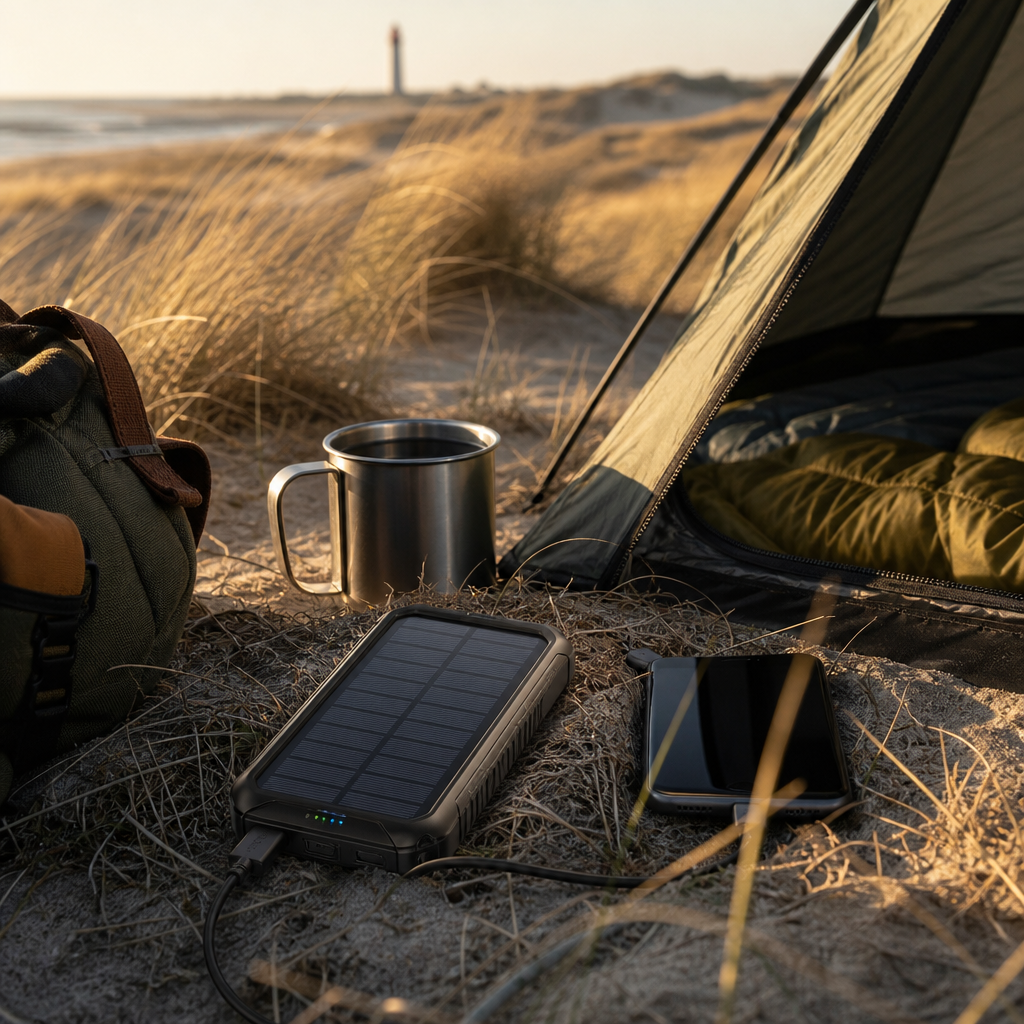
A solar power bank is especially useful if you spend a lot of time outdoors and do not always have a power socket nearby. Think camping, festivals, hikes, cycling trips or emergencies on the go. The big advantage is clear: you have a portable solar charger with you that can top up not only by cable, but also through sunlight.
At the same time, it is important to keep your expectations realistic. A power bank with a solar panel is rarely intended as a full replacement for mains power. The built-in panel mainly works as an extra backup or a slow top-up during the day. If you want to choose wisely, do not just look at capacity, but also at charging speed, ports, weather resistance and panel quality.
When solar power really gives you an advantage on the go
A solar power bank, also known as an external battery with solar charging, is made for situations where flexibility matters more than pure charging speed. You fully charge the power bank at home via USB-C or with a mains charger and then use sunlight to build up extra energy while you are out and about. This keeps your smartphone, navigation device or earbuds usable for longer without relying directly on a power socket.
A solar power bank is especially practical in these situations:
- multi-day camping trips without fixed power points
- festivals and weekends away
- walking trips, backpacking and cycling holidays
- emergency kits for the car, boat or home
- everyday use as extra peace of mind on long travel days
For a short city break or a workday with enough charging points, a standard power bank is often the more sensible choice. It is usually more compact, lighter and faster to recharge. So the strength of a solar power bank is not convenience indoors, but extra independence outdoors.
How charging with sunlight works in practice
A power bank with a solar panel converts light into electrical energy and stores it in the built-in battery. That principle sounds simple, but the yield depends heavily on the conditions. Direct sunlight works best. Shade, cloud cover, the wrong angle or a dirty panel immediately reduce the output. That is why charging a power bank with a solar panel is much slower in practice than charging from a power socket or a fast USB-C charger.
Most models with an integrated solar panel have a relatively small panel. That is handy for emergency charging and gradual top-ups, but not ideal for filling a large battery quickly. If you mainly see a product as a solar phone charger, it is worth knowing that a separate foldable solar panel usually delivers more energy than the small panel on the back of a power bank. For genuinely extended off-grid use, that combination is often more efficient.
The best approach is therefore simple: fully charge your solar power bank at home first, use it in direct sunlight during the day as an extra top-up, and treat solar power as a bonus backup. That makes charging your phone with solar power practical, without leaving you disappointed on the road because of unrealistic expectations.
Solar power bank or standard power bank?
Are you hesitating between a standard power bank and a solar charger? Then the choice mainly depends on how you plan to use it. A standard power bank is usually smaller, lighter and quicker to charge. A solar power bank, on the other hand, offers more self-sufficiency when you are outdoors for longer and cannot rely on power sockets.
The differences quickly become clear in practice:
| Feature | Standard power bank | Power bank with solar panel |
|---|---|---|
| Charging the power bank | Via mains power or USB | Via mains power or USB, plus top-up from sunlight |
| Charging speed | Usually faster | Sunlight is clearly slower |
| Size and weight | Often more compact | Often slightly larger and heavier |
| Outdoor use | Fine for general use | Often better suited to outdoor use and emergencies |
| Best choice for | Daily use, commuting, city breaks | Camping, festivals, hikes, off-grid travel |
If speed and convenience are your priorities, a standard power bank wins. If you want extra reassurance when you are away from home, a solar power bank is a smart upgrade. So the best choice is not automatically the most advanced one, but the version that suits your routine and destination.
Which capacity suits your needs?
Capacity, expressed in mAh, determines how much backup power you take with you. Even so, the number on the packaging does not tell the whole story. Charging always involves some energy loss because of conversion, heat and cable resistance. Wireless charging also uses more energy than charging by cable. As a result, in practice you will get fewer full phone charges than the raw mAh figure suggests.
For most users, this breakdown works well:
- 10,000 mAh - compact and light, suitable for a day trip or as emergency backup. Roughly expect about 1.5 to 2 smartphone charges, depending on the device and charging method.
- 20,000 mAh - the most popular middle ground. A 20,000 mAh solar power bank is a good match for weekend trips, camping and heavier use. In practice, 3 to 4 top-ups are often achievable.
- 30,000 mAh - interesting for longer trips, multiple devices or sharing with travel companions. You get more reserve, but also more weight and a larger size.
If you charge not only a phone, but also earbuds, a smartwatch, a camera or a small tablet, it is better to choose more capacity. If you want to make serious use of mobile solar charging over several days outdoors, 20,000 mAh or more is usually more satisfying than a very compact entry-level model.
What should you look for in the best power bank with a solar panel?
You do not recognise the best solar power bank by one standalone specification. It is the combination of battery capacity, charging technology, build quality and genuinely useful extra features that determines whether a model really delivers when you are on the move.
Charging speed, ports and efficiency
For modern smartphones, a fast USB-C port is a major plus. Especially if you use an iPhone, Samsung or another recent phone, 18W, 20W or more is much more comfortable than a basic slow output. If you also want to charge a tablet, handheld or multiple accessories, look carefully at both the number of ports and the total output.
USB-C, USB-A and wireless charging
USB-C is generally the best choice for speed and efficiency. USB-A remains useful for older cables and accessories. Some models also offer wireless charging. That is convenient, but less efficient than charging by cable. If you want the fastest results, a cable is almost always better. If you use Apple devices, it is also best to choose a good MFi-certified cable for stable and safe charging.
Multiple devices and pass-through charging
A solar power bank can often charge multiple devices at the same time, but the available output is then shared. If you want to charge one phone as quickly as possible, it is usually best to use only the most powerful USB-C port. Some models support pass-through charging: the power bank itself is then charged while it powers a device at the same time. That is handy at the campsite or on the go, but it is usually less efficient and slower than charging it first and then using it separately.
Ruggedness for camping, festivals and hikes
For outdoor use, more than just battery capacity matters. A good solar power bank should be able to handle dust, splashes and knocks. Rubberised edges, sealed ports and a sturdy housing make a big difference in practice. Especially on a festival site, on the bike or in a rucksack, you do not want a fragile model that already shows signs of wear after a few days outdoors.
What IP65 or IP67 means in practice
An IP rating shows how well a product is protected against dust and water. IP65 usually means that splashes and dust are not a major issue. IP67 goes further and can withstand temporary immersion, but only if the manufacturer explicitly specifies this and all covers are properly closed. Note that water-resistant is not the same as carefree use underwater. Keep ports dry and clean, especially before you start charging.
Extra features that are genuinely useful
Extras are only valuable if they add something on the go. An LED torch or SOS function is useful for camping and emergencies. A clear battery indicator prevents surprises. A carabiner or loop makes it easier to attach to a bag, although charging in direct sunlight works better than dangling in the shade. Built-in cables are practical, but a separate quality cable is often still better for fast and reliable charging.
Practical tips for faster and safer charging
With a few simple habits, you can get noticeably more out of a solar phone charger or power bank with a solar panel:
- fully charge the power bank at home before you leave
- place the panel in direct sunlight and point it as directly at the sun as possible
- avoid shade, dirt and overheating behind car windows or on hot metal
- use short, good-quality cables to reduce energy loss
- keep ports dry, especially after rain or a dusty trip
- preferably do not store the battery completely empty or completely full for long periods
- top up a rarely used power bank every few months
If you mainly use a solar phone charger as an emergency backup, it is wise to check the battery level regularly. That way, you avoid leaving a device unused for months and finding out it is empty at exactly the wrong moment.
Can a solar power bank go on a plane?
Yes, in many cases it can, but nearly always in carry-on baggage only and not in checked luggage. Airline rules look not only at mAh, but mainly at Wh. A useful rule of thumb is: Wh = mAh x 3.7 / 1000. That means 20,000 mAh comes to about 74 Wh and 30,000 mAh to about 111 Wh.
Up to 100 Wh, taking it with you is often allowed, depending on the airline. Between 100 and 160 Wh, prior approval is sometimes required. That is why a 20,000 mAh solar power bank is usually a safer choice for air travel than a 30,000 mAh model. Always check the current rules for power banks on planes from your airline, especially on international flights.
Frequently asked questions about solar power banks
Can a solar power bank become fully charged through sunlight?
Yes, technically it can, but in practice it often takes a long time. With a power bank that has a small integrated solar panel, sunlight is mainly intended for extra top-ups. For fully charging it, USB-C or mains power remains much faster. If you really want to charge off-grid for long periods, it is better to choose a larger external solar panel combined with a power bank.
How long does charging with solar power take?
That depends on the battery capacity, the size and efficiency of the panel, the strength of the sun and the angle to the sun. In bright direct sunlight, you can gradually build up energy, but a full charge often takes many hours or may even need to be spread across several parts of the day. By cable, it is almost always considerably faster.
Does a solar phone charger also work in cloudy weather?
Yes, but with a much lower yield. A solar phone charger works best in direct sunlight without shade. In cloudy weather, behind glass or at an unfavourable angle, efficiency drops sharply. So treat cloudy conditions as an extra top-up, not as the main way to charge your power bank or phone quickly.
Can I charge an iPhone, Samsung or iPad directly?
Yes, that is exactly the purpose of a solar power bank. You charge your devices directly via USB-C or USB-A, and sometimes wirelessly if the model supports it. For an iPad or other larger devices, sufficient output power is important. For iPhone use, an MFi-certified cable is a sensible choice.
Is a separate solar panel for charging a phone smarter than a power bank with a solar panel?
For serious multi-day outdoor trips, often yes. A separate foldable solar panel usually delivers more power than the small panel on a solar power bank. For daily use, festivals or an emergency kit, a compact solar power bank is more convenient precisely because the battery and backup solution are combined in one device.
If you choose a solar power bank, pay particular attention to realistic performance, solid build quality and safe, certified accessories. CE and RoHS-compliant products and quality cables genuinely make a difference on the go. That way, you can charge your smartphone, tablet or other mobile devices more safely, more efficiently and with greater confidence.